Blue Economy Innovation
Tracking Impacts: Understanding the Deeper Value of Innovation

The blue economy extends beyond ships, ports, and ocean-based industries, supporting thriving coastal communities and offering good jobs, while protecting marine ecosystems and moving towards a more resilient future. Yet measuring such broad outcomes has often been difficult.

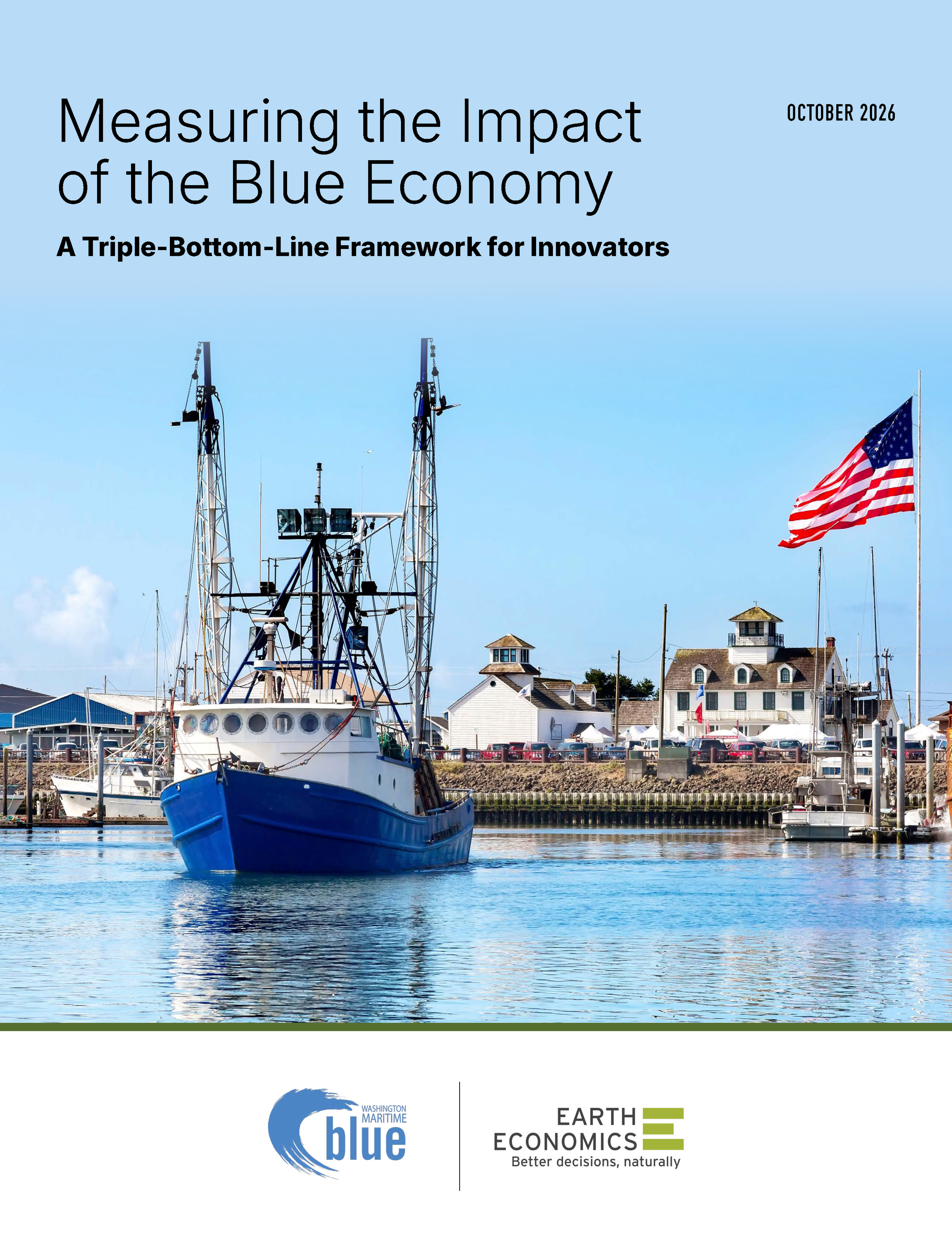
To address this challenge, Maritime Blue and Earth Economics partnered to create the Blue Economy Impact (BEI) Framework: a practical tool to help innovators understand and communicate the real-world impacts of innovations and investments in the blue economy.
The BEI Framework provides a common approach for tracking contributions to economic growth, environmental stewardship, and community well-being. Whether evaluating new technologies, infrastructure investments, workforce initiatives, or restoration efforts, the BEI Framework can help organizations connect their activities to measurable outcomes.
By helping organizations identify what matters, the framework supports better decision-making, more effective investments, and clearer communication of impacts. Identifying and then tracking the KPIs most relevant to their projects can also help innovators identify opportunities, better understand trade-offs, and demonstrate how innovation can create lasting benefits for people, communities, businesses, and the environment.
The BEI is designed to support those who are
developing a new technology by helping to identify relevant indicators early in the design process;
seeking funding or investment by establishing an approach for demonstrating potential sustainability benefits;
monitoring performance by highlighting key data and baselines necessary to track performance; or
managing a portfolio by identifying common measures, making it easier to assess potential trade-offs.

Assembled from leading international and regional impact frameworks, the BEI Framework includes a carefully selected set of key performance indicators (KPIs) relevant to Maritime Blue's current priority areas.
The BEI Framework provides a starting point for selecting meaningful indicators, establishing monitoring priorities, and developing more comprehensive impact assessments.
The full report describes describes how the term “Blue Economy” first emerged and its relevance to broader environmental, economic, and social sustainability initiatives, followed by a discussion of seven KPI frameworks that largely informed the BEI Framework, a hypothetical case study (Green Hydrogen at the Port of Tacoma), and guidance on future monitoring and data needs. The appendices address limitations inherent in developing the BEI Framework, describe a simple survey instrument to help innovators identify the KPIs most-relevant to their work, and a list of all BEI KPIs, with associated
Access the Blue Economy Impact Framework Report
Please fill out the form below to access the full report.
Your information will be kept confidential, and we will never share or sell it to third parties.
About the Partnership
The Blue Economy Impact Framework was developed through a collaboration between Maritime Blue and Earth Economics. Combining Maritime Blue's leadership in blue economy innovation with Earth Economics' expertise in economic and environmental analysis, the partnership created a shared framework for understanding and measuring the broader impacts of emerging ocean industries.
Together, the organizations are helping build a future where innovation is not measured solely by financial returns, but also by its contributions to healthy ecosystems, strong communities, and a sustainable blue economy.