The Power of Peatlands in Capturing Carbon
Peatlands are unique and vulnerable ecosystems that capture and sequester massive amounts of carbon, storing more carbon than all tropical forests, but covers just a fraction of land globally.
Yet peatlands are often degraded by human activities—they are vulnerable to drainage for agriculture and development, a changing climate, and especially wildfire—which can release that accumulated carbon and other harmful pollutants.
Estimating the economic value of peatland benefits helps to ensure that their contributions to human wellbeing are fully considered in decisions about land use, restoration financing, and development.
Peatland valuation research
With support from the Laird Norton Family Foundation, we reviewed the scholarly literature on peatland benefits to identify additional unique benefits and determine whether peatlands should be valued separately from wetlands.
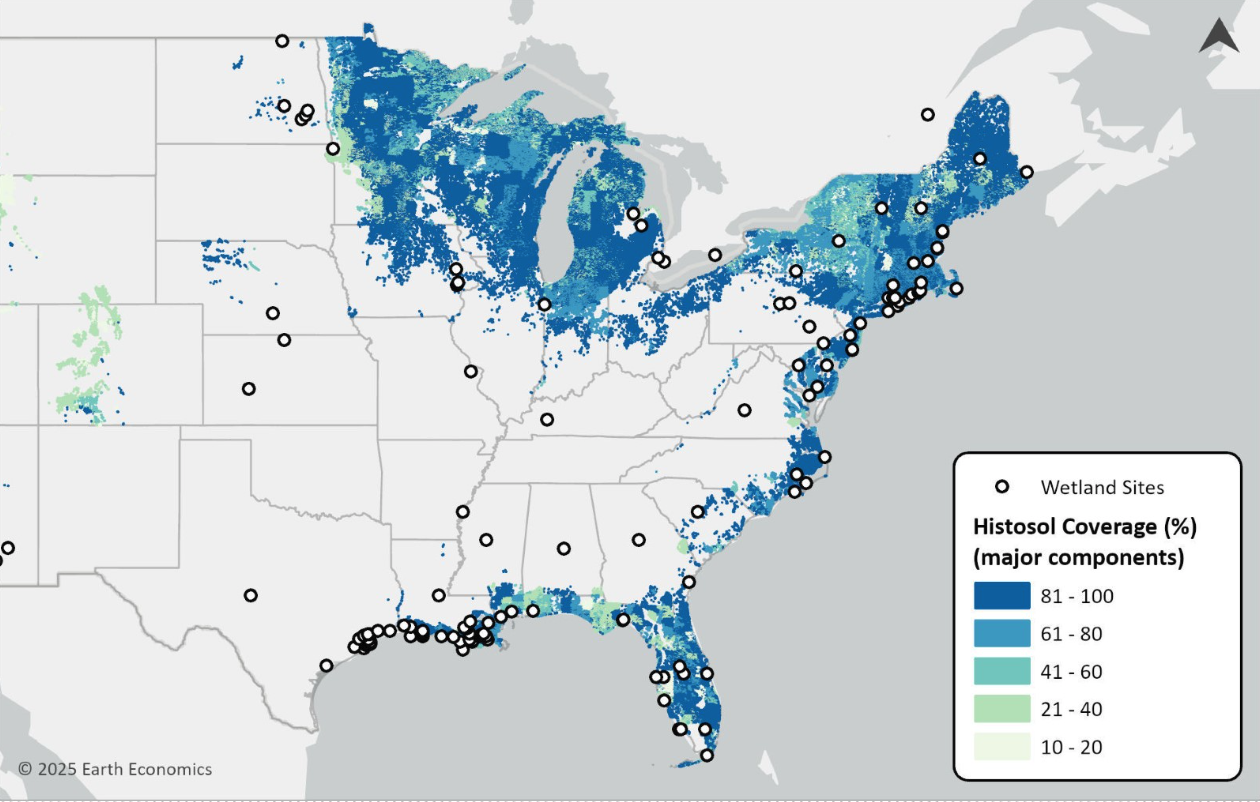
The analysis draws on our internal database of ecosystem services to estimate the broader value of benefits provided by peatlands. Using a tool developed by PeatRestore, we mapped values for wetland ecosystems that could potentially be reclassified as peatlands. By determining which study sites were located on histosol soils, we identifies studies where wetlands could be reclassified as peatlands, to better quantify and communicate peatland value.
While our database had just 20 values explicitly focused on peatlands in the United States (California and North Carolina) it has 672 values for wetland ecosystems. Of these, 34 estimates from five studies were conducted on wetlands with histosol soils that could be potentially reclassified as peatlands.
Key takeaways
Since 1985, most peatland valuation research has focused on carbon storage and climate regulation services. Research on the value of other ecosystem service benefits remains limited.
However, peatlands provide several important ecosystem services, including…
Contributing to late-season water supply, as shown in Alaska where peatlands covered just 0.5 percent of a watershed, yet supported more than half of summer streamflow
Storing mercury over long periods due to strong chemical bonds between mercury and organic matter
Vulnerability to disturbance, including the release of stored mercury and other pollutants
High sensitivity to drought, drainage, and fire, since peat soils can burn for a long time, peat fires often emit more carbon, mercury, particulates, and toxic compounds than fires in mineral soil wetlands
Overall, the literature suggests that wetlands provide valuable services that may be strongly expressed in peatlands, and that these services can be significantly degraded by drainage, drought, or fire.
If you’re interested in the full literature review, please reach out to us at info@eartheconomics.org.
Further research is needed
This review indicates that, apart from carbon sequestration, peatlands deliver benefits similar to wetlands, but that differences in ecosystem function and value are not well-understood.
Future research could compare peatland and wetland values from otherwise similar sites, examining any differences in biophysical outputs. Additional work is also needed to estimate the broader value provided by peatland ecosystems, beyond climate sequestration and storage. Developing a benefit-cost analysis framework for management scenarios that would articulate the benefits of peatland protection and restoration scenarios could also improve policy and decision-making outcomes.