Redefining Disaster Mitigation with FEMA
For over a dozen years, Earth Economics has played a unique role in helping the Federal Emergency Management Agency (FEMA) better account for the value of nature in disaster mitigation.
Our work has shaped national policy and tools and helped communities secure FEMA funding for nature‑based resilience projects. We approach this work at two levels:

Updating FEMA Standards
We’ve helped influence how FEMA evaluates and funds disaster mitigation, successfully embedding nature-based solutions into national policy and tools.

Supporting FEMA Applicants
We help communities successfully compete for FEMA funding, by helping them develop credible benefit‑cost analyses which integrate the value of nature-based solutions.
Need support with your BRIC analysis? Contact us
In 2027, FEMA is likely to reopen applications to distribute $1 billion in funding through the Building Resilient Infrastructure and Communities (BRIC) program. This supports states, Tribes, and local governments in advancing projects that reduce disaster risk before disasters occur.
It’s a great time to start thinking about your application—and we’re here to help.
Applying for BRIC funding requires strong benefit–cost analysis and clear articulation of risk reduction benefits. Our deep experience with FEMA economic frameworks helps us to quantify avoided losses, demonstrating the cost‑effectiveness of nature‑based and resilience‑focused projects.
Send us a note at info@eartheconomics.org to get in touch.
Updating FEMA Standards
Federal Funding of Nature‑Based Disaster Mitigation Solutions
Until relatively recently, FEMA disaster mitigation funding focused narrowly on built infrastructure to reduce future property damage. This framework made it difficult for nature‑based solutions—floodplain restoration, green infrastructure, post‑wildfire landscape recovery—to compete for funding.
Since 2013, Earth Economics has worked directly with FEMA to modernize how disaster mitigation benefits are evaluated. We helped to develop the economic frameworks, valuation methods, and standardized ecosystem service values that enabled natural systems to be included in the agency’s benefit–cost analyses.
Our efforts helped FEMA:
Recognize ecosystem services as legitimate, quantifiable benefits
Gradually expand eligible project types to include a broader range of nature‑based mitigation strategies
Reduce barriers that had prevented nature-based projects from being considered cost‑effective
Our History with FEMA
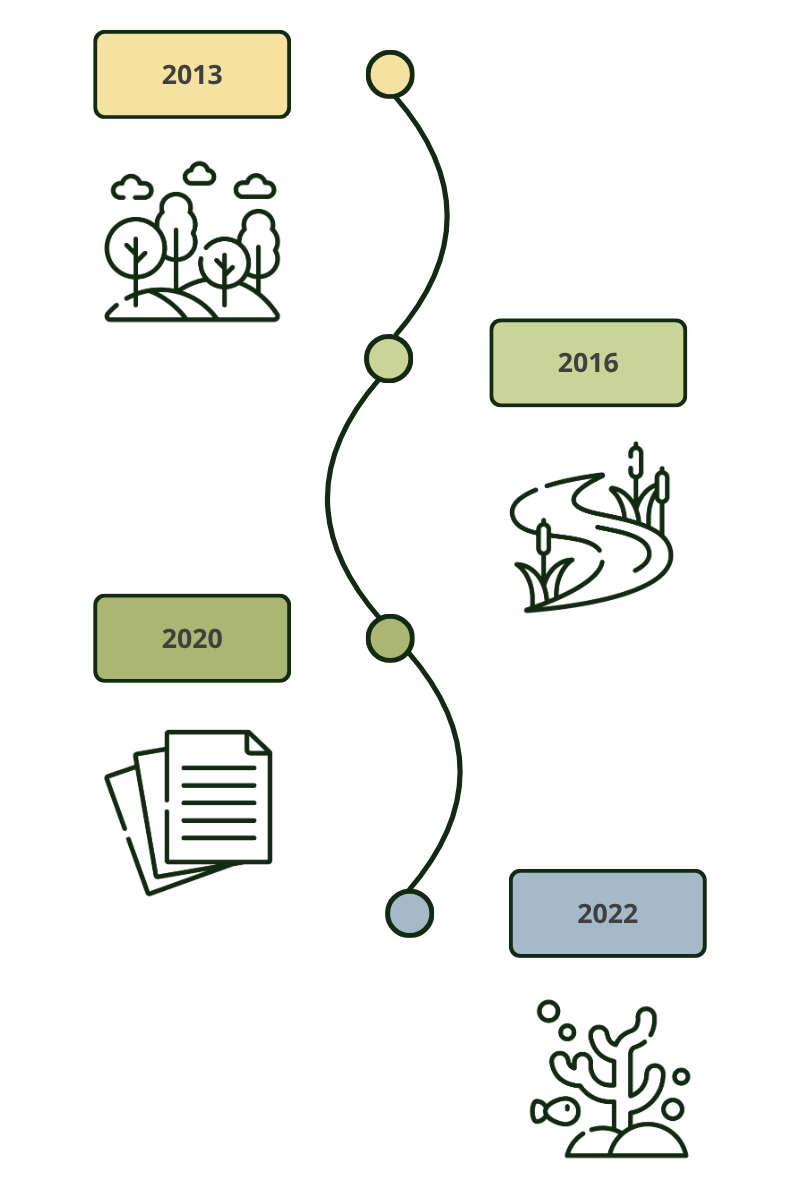
2013 – Developed the first national ecosystem service values approved by FEMA and supported their initial policy allowing the inclusion of environmental benefits in hazard‑mitigation benefit-cost analyses
2016 – Expanded the range of FEMA‑approved ecosystem services and supported opening eligibility to restoration, green infrastructure, post‑wildfire mitigation, and aquifer recharge projects
2020 – Supported an update to FEMA policy, removing the benefit-cost threshold that had limited the inclusion of ecosystem services in project benefits
2022 – Led a major expansion of the FEMA Benefit Cost Toolkit, adding new landcover types (such as coral reefs and beaches), ecosystem services, and green infrastructure benefits
The Impact
Nature‑based solutions are now embedded in FEMA’s national decision‑making tools and policies. This shift influences how mitigation projects across the country are evaluated, making it easier for communities to pursue, justify, and fund nature-based solutions to mitigate disaster risk.
In practice, this means FEMA can now support projects that:
Reduce future losses with nature-based solutions that deliver broader community benefits
Address compound risks, such as flooding, wildfire, and drought
Invest in long‑term resilience, helping communities to escape cycles of disaster and recovery
Supporting FEMA Applicants
Helping Communities Secure FEMA Disaster Mitigation Funding
The application process for FEMA mitigation funding is technically complex and highly competitive. Even well-designed projects can be rejected because they lack FEMA‑compliant economic justification or fail to clearly demonstrate cost‑effectiveness under federal criteria.
Earth Economics works with communities, Tribes, agencies, and other partners to translate nature‑based resilience solutions into FEMA‑ready applications. Drawing on our deep familiarity with FEMA benefit–cost requirements, we provide analysis that meets federal standards and leads to stronger funding proposals.
Our support includes:
FEMA‑compliant benefit-cost analysis
Quantification of avoided losses and ecosystem service benefits
Strategic framing of projects to align with FEMA program goals
This work has helped communities move from concept to implementation, successfully competing for FEMA mitigation funding to reduce disaster risk, protect people and infrastructure, and invest in more resilient landscapes.

CASE STUDY
After a series of catastrophic wildfires, Sonoma County, CA wanted to be proactive in reducing wildfire risk. The County developed innovative mitigation strategies, including vegetation management, defensible space, and landscape‑scale fuel breaks. But they needed to demonstrate that these investments were cost‑effective under FEMA’s strict benefit–cost requirements.
In 2019, Earth Economics supported Sonoma County by providing FEMA‑compliant benefit–cost analysis that quantified the avoided losses and broader benefits of wildfire mitigation, including nature‑based approaches. We translated complex ecological and risk‑reduction outcomes into economic terms for FEMA evaluation—strengthening the County’s Building Resilient Infrastructure and Communities (BRIC) application.
Sonoma County secured $37 million in FEMA BRIC funding for wildfire mitigation—one of the first large‑scale awards of its kind. The project was publicly announced by President Biden in 2021, highlighting the program as a national example of proactive, innovative wildfire mitigation.
Disaster mitigation decisions can shape communities for decades. Where nature has been undervalued, cost-effective opportunities to reduce risk while improving local quality of life can be missed.
By helping FEMA change how they measure benefits—and helping communities succeed within that system—Earth Economics has helped to open a door to disaster mitigation strategies that work with natural systems, rather than against them.
With questions or inquiries about this work, please reach out at info@eartheconomics.org.